



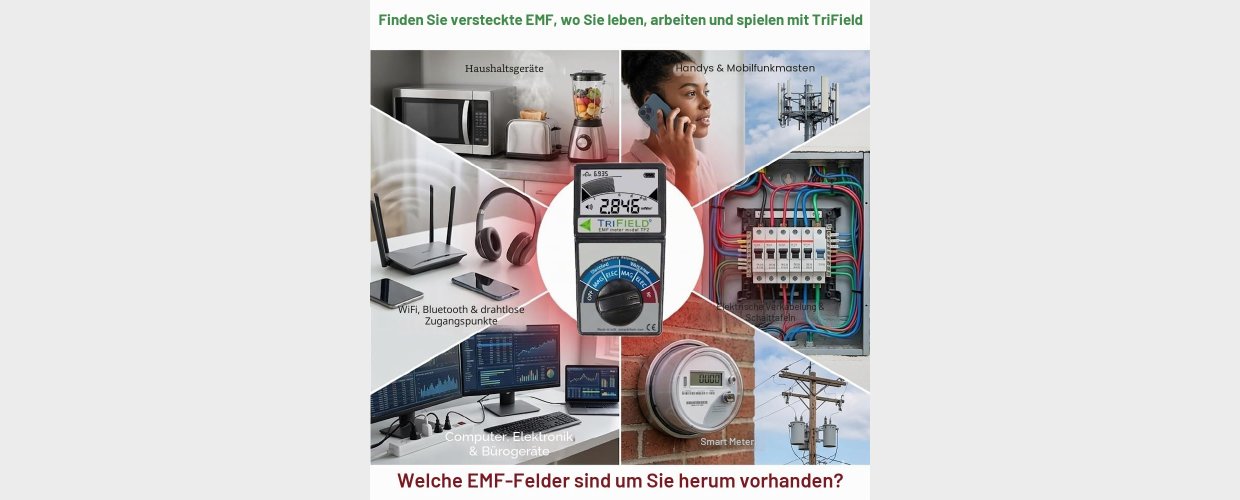
Many people today are surrounded by electrical devices, WiFi routers, mobile phones, smart meters, electric cars, computers and household appliances. All of these can create different types of electromagnetic fields, also called EMF.
With an EMF meter such as the TriField TF2, it is possible to measure different types of electromagnetic fields in your home, workplace, car and sleeping area. This can help you find hidden EMF sources and reduce unnecessary exposure, especially in places where you spend many hours every day.
This article explains how to understand the different settings on an EMF meter, what the measurements mean, and how a holistic or alternative health practitioner may interpret low, moderate and high EMF exposure.
Important Note
This article is written from a precautionary and holistic health perspective. It does not claim that EMF exposure causes cancer or that reducing EMF exposure can treat or cure disease.
Official EMF safety limits are much higher than the precautionary values often used by building biologists and alternative health practitioners. From a holistic perspective, the goal is usually simple:
Reduce unnecessary EMF exposure as much as reasonably possible, especially in the bedroom and during sleep.
This is particularly relevant for people who are sensitive, chronically ill or simply want to create a cleaner and more restful living environment.
What Does an EMF Meter Measure?
An EMF meter can usually measure three main types of electromagnetic fields:
1. Magnetic Fields
Magnetic fields are often created by electrical current flowing through wires, motors, transformers, electrical panels, chargers and electric vehicles.
On the TriField TF2, this is measured using:
MAG Standard
MAG Weighted
Magnetic fields are usually shown in:
mG — milligauss
Typical sources include:
Electrical panels
Power cables
Transformers
Electric motors
Induction cookers
Electric cars
Chargers
Appliances
Heating systems
Magnetic fields are important because they can pass through walls and are often difficult to shield. The best solution is usually distance from the source.
2. Electric Fields
Electric fields are created by voltage. They can be present around wires, lamps, extension cords, chargers and electrical devices, even when very little current is flowing.
On the TriField TF2, this is measured using:
ELEC Standard
ELEC Weighted
Electric fields are usually shown in:
V/m — volts per meter
Typical sources include:
Bedside lamps
Extension cords
Cables near the bed
Laptop chargers
Ungrounded appliances
Walls with electrical wiring
Electrical sockets
LED power supplies
Electric fields can often be reduced by moving cables away from the body, using grounded equipment or switching off power at night.
3. RF Radiation / Radio Frequency Radiation
RF stands for radio frequency. This is the type of radiation used by wireless technology.
On the TriField TF2, this is measured using:
RF
RF radiation is usually shown in:
mW/m² — milliwatts per square meter
Typical sources include:
WiFi routers
Mobile phones
Bluetooth devices
Smart meters
Wireless cameras
Baby monitors
Mobile phone masts
Wireless headphones
Tablets and laptops using WiFi
RF radiation can often be reduced by using wired internet, turning off WiFi at night and keeping wireless devices away from the bed.
Understanding the TriField TF2 Settings
MAG Standard
This setting measures standard magnetic fields.
Use this setting when you want to find magnetic fields from electrical current, cables, motors, electrical panels, transformers, household appliances and electric vehicles.
This is useful for finding the source of magnetic field exposure.
MAG Weighted
This setting measures magnetic fields with a biological weighting.
From a holistic health perspective, MAG Weighted is often the most useful magnetic field setting, because it gives more weight to frequencies that may be more relevant to the human body.
Use this setting when measuring:
Beds
Sofas
Workstations
Electric cars
Electrical panels
Areas where people spend a long time
ELEC Standard
This setting measures standard electric fields.
Use this setting to find electric fields from wires, lamps, chargers, extension cords and electrical devices.
This is especially useful around the bed.
ELEC Weighted
This setting measures electric fields with a biological weighting.
From an alternative health perspective, this can be useful when checking whether the body may be exposed to electric fields while sleeping, resting or working.
RF
This setting measures radio frequency radiation from wireless devices.
Use this setting to test:
WiFi routers
Mobile phones
Bluetooth devices
Smart meters
Wireless cameras
Mobile phone masts
Wireless speakers
Wireless headphones
RF measurements often change quickly, because wireless devices send signals in pulses.
Precautionary EMF Values from a Holistic Perspective
The following values are not official legal safety limits. They are practical precautionary values often used by people who want to reduce EMF exposure in the home.
The most important place to keep EMF levels low is the sleeping area, because the body rests, repairs and regenerates during sleep.
Magnetic Fields — MAG
Measured in:
mG — milligauss
Suggested Precautionary Values
| Magnetic Field Level | Holistic Interpretation |
|---|---|
| Under 0.2 mG | Very low / excellent |
| 0.2 – 1.0 mG | Slightly elevated, often acceptable |
| 1.0 – 5.0 mG | Too high for long-term exposure, especially near the bed |
| Over 5.0 mG | High hotspot, should be investigated |
Practical Advice
For a sleeping area, a holistic practitioner would usually prefer:
Below 0.2–0.5 mG if possible
Below 1.0 mG as a practical maximum
For short-term exposure, such as driving an electric car, the tolerance may be slightly higher. However, if high levels are found near the body for long periods, it may be worth investigating further.
Electric Fields — ELEC
Measured in:
V/m — volts per meter
Suggested Precautionary Values
| Electric Field Level | Holistic Interpretation |
|---|---|
| Under 5 V/m | Good |
| 5 – 50 V/m | Elevated |
| Over 50 V/m | High |
| Over 100 V/m | Very high for a living or sleeping area |
Practical Advice
For the sleeping area, a holistic practitioner would usually prefer:
Below 5 V/m if possible
Common sources of high electric fields near the bed include:
Bedside lamps
Extension cords
Chargers
Power cables behind the headboard
Ungrounded devices
Electrical wiring inside the wall
Simple improvements can include moving cables away from the bed, unplugging chargers at night and using grounded equipment where possible.
RF Radiation — WiFi, Mobile Phones and Smart Meters
Measured in:
mW/m² — milliwatts per square meter
Important conversion:
1 mW/m² = 1000 µW/m²
Suggested Precautionary Values
| RF Level on Meter | Holistic Interpretation |
|---|---|
| Under 0.001 mW/m² | Very low |
| 0.001 – 0.01 mW/m² | Low to moderate |
| 0.01 – 1.0 mW/m² | Elevated |
| Over 1.0 mW/m² | High from a precautionary perspective |
Practical Advice
For the sleeping area, a holistic practitioner would usually prefer:
Below 0.01 mW/m²
Even better: as close to 0.001 mW/m² as possible
Common RF sources include:
WiFi routers
Mobile phones
Smart meters
Bluetooth devices
Wireless cameras
Wireless speakers
Mobile masts outside the home
The easiest way to reduce RF exposure at night is to turn off WiFi, keep the mobile phone away from the bed, and use wired internet where possible.
How to Measure EMF in Your Home
To get useful measurements, always measure where the body actually is.
For example:
At the pillow
At chest height in the bed
At the sofa
At the office chair
At the desk
Inside the electric car
Near the electrical panel
Near the WiFi router
Do not only measure directly on top of a device. A very high reading close to a cable may not matter much if nobody spends time there. What matters most is the exposure where people sleep, sit, work or rest for many hours.
Step-by-Step EMF Testing Guide
1. Measure the Bed First
The bedroom is usually the most important place to start.
Measure:
On the pillow
At chest height
At the foot of the bed
Behind the headboard
Near bedside lamps
Near sockets and extension cords
On the wall behind the bed
Use:
MAG Weighted
ELEC Weighted
RF
Then turn off WiFi, unplug chargers and switch off lamps. Measure again and compare the difference.
2. Measure the WiFi Router
Measure RF radiation at different distances:
30 cm from the router
1 meter from the router
2 meters from the router
At the bed
At the desk
In the living room
If the RF level is high in the sleeping area, consider moving the router, turning it off at night or using wired internet.
3. Measure the Electrical Panel
Use MAG mode near the electrical panel.
Also measure the other side of the wall if there is a bed, sofa or desk behind it.
Magnetic fields from electrical panels can sometimes pass through walls.
4. Measure Your Work Area
Check:
Computer
Monitors
Laptop charger
Power strips
Extension cords
WiFi devices
Bluetooth devices
Printer
Desk lamps
Use:
MAG Weighted
ELEC Weighted
RF
Many people spend several hours every day at their desk, so reducing unnecessary exposure here can be useful.
5. Measure an Electric Car
When measuring an electric car, use especially:
MAG Weighted
Measure:
Driver’s seat
Passenger seat
Footwell
Back seat
Near the battery area
While parked
While driving
While charging
A holistic practitioner would usually not panic about short-term exposure, but would still prefer lower readings near the body, especially if the person drives many hours every day.
Practical Holistic Guidelines
From a holistic health perspective, the goal is not to create fear. The goal is to reduce unnecessary exposure in a practical way.
Best Priority Areas
The most important places to improve are:
The bed
The sleeping area
The work desk
The sofa
Children’s rooms
Areas used by sick or sensitive people
Simple Ways to Reduce EMF Exposure
Turn off WiFi at night
Do not sleep with a mobile phone next to your head
Use airplane mode when possible
Use wired internet instead of WiFi
Move the bed away from electrical panels
Remove chargers from the bedroom
Avoid extension cords under or behind the bed
Move WiFi routers away from resting areas
Keep distance from high-field devices
Use wired headphones instead of Bluetooth when possible
Simple Rule of Thumb
For a person who is sick, sensitive or wants to reduce unnecessary exposure, a holistic practitioner would often think like this:
Sleeping area: Be strict. Keep levels as low as possible.
Work area: Reduce what is easy to reduce.
Electric car: Measure and avoid unnecessary long-term high exposure.
WiFi and mobile phones: Keep them away from the bed, especially at night.
Hotspots: A high reading close to a device is less important than a high reading where the body stays for many hours.
The most important question is: